Portfolio Project
Product Feedback Synthesizer
An AI-powered product intelligence app with MCP capabilities that turns raw customer feedback into prioritized roadmap insights, executive summaries, and agent-accessible product recommendations.
Jun 2026
Overview
Product Feedback Synthesizer is a public portfolio prototype designed to demonstrate how AI can transform scattered product feedback into structured product intelligence. The application ingests feedback from demo datasets, pasted text, and CSV-style workflows, then synthesizes that input into themes, pain points, feature requests, roadmap opportunities, and grounded follow-up answers. A human user can access the workflow through a web dashboard and chat interface, while an AI agent can access the same workflow through an MCP server that exposes structured tools. The result is both a usable product analytics prototype and a demonstration of how MCP can make product workflows available to AI agents and third-party developer tools.
Problem
Product teams often collect large volumes of feedback across reviews, support tickets, sales notes, user interviews, social channels, and internal documents. The challenge is not simply storing that feedback; it is converting noisy, repetitive, and unstructured input into clear product themes, customer pain points, evidence-backed priorities, and roadmap recommendations quickly enough to support decision-making.
The application also addresses a second problem: most product workflows are locked behind human-facing web interfaces. By exposing key actions through an MCP server, the Product Feedback Synthesizer allows AI agents and developer tools to create feedback sets, ingest feedback, run synthesis, retrieve analysis bundles, and ask grounded follow-up questions without relying on the web UI.
Approach
The application is built around two complementary workflows: a human web workflow and an AI agent / MCP workflow.
The human workflow uses a Next.js web application hosted on Vercel. Users can start from a landing page, choose a demo or custom feedback path, ingest feedback through paste or CSV-style flows, run synthesis, review the resulting dashboard, and ask follow-up questions through chat.
The backend is a FastAPI service hosted on Railway. It handles feedback ingestion, synthesis orchestration, chat, dashboard-ready analysis bundles, and deterministic fallback behavior when the LLM layer is unavailable. Supabase provides persistence for feedback sets, analysis runs, chat messages, and related application data. OpenAI provides the LLM synthesis and grounded follow-up chat capabilities.
The agent workflow adds an MCP server, also deployed on Railway. The MCP server acts as a thin protocol and tool layer over the backend, exposing structured tools such as create_feedback_set, add_pasted_feedback, run_synthesis, get_analysis_bundle, and ask_analysis_question. MCP clients such as Claude Desktop, Cursor, custom clients, or a demo route can discover these tools, inspect input schemas, make structured tool calls, and receive structured responses backed by the same FastAPI workflow used by the web application.
Application Architecture
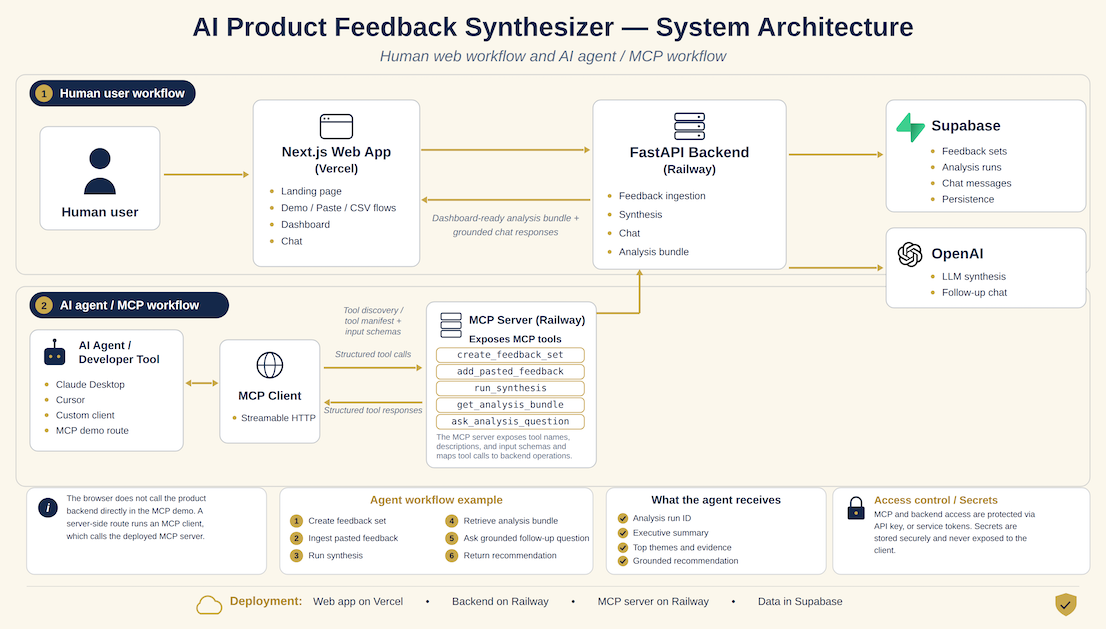
At a high level, both paths converge on the same backend intelligence layer. The web app makes the workflow usable for humans, while the MCP layer makes the workflow usable for agents and third-party tools.
Try the Product Feedback Synthesizer
Outcome
The outcome is a working prototype that demonstrates how product feedback can be converted into an intelligence layer rather than remaining as raw, manual-review data. The dashboard surfaces executive summaries, top themes, supporting evidence, pain points, feature requests, roadmap implications, and follow-up answers grounded in the synthesized analysis.
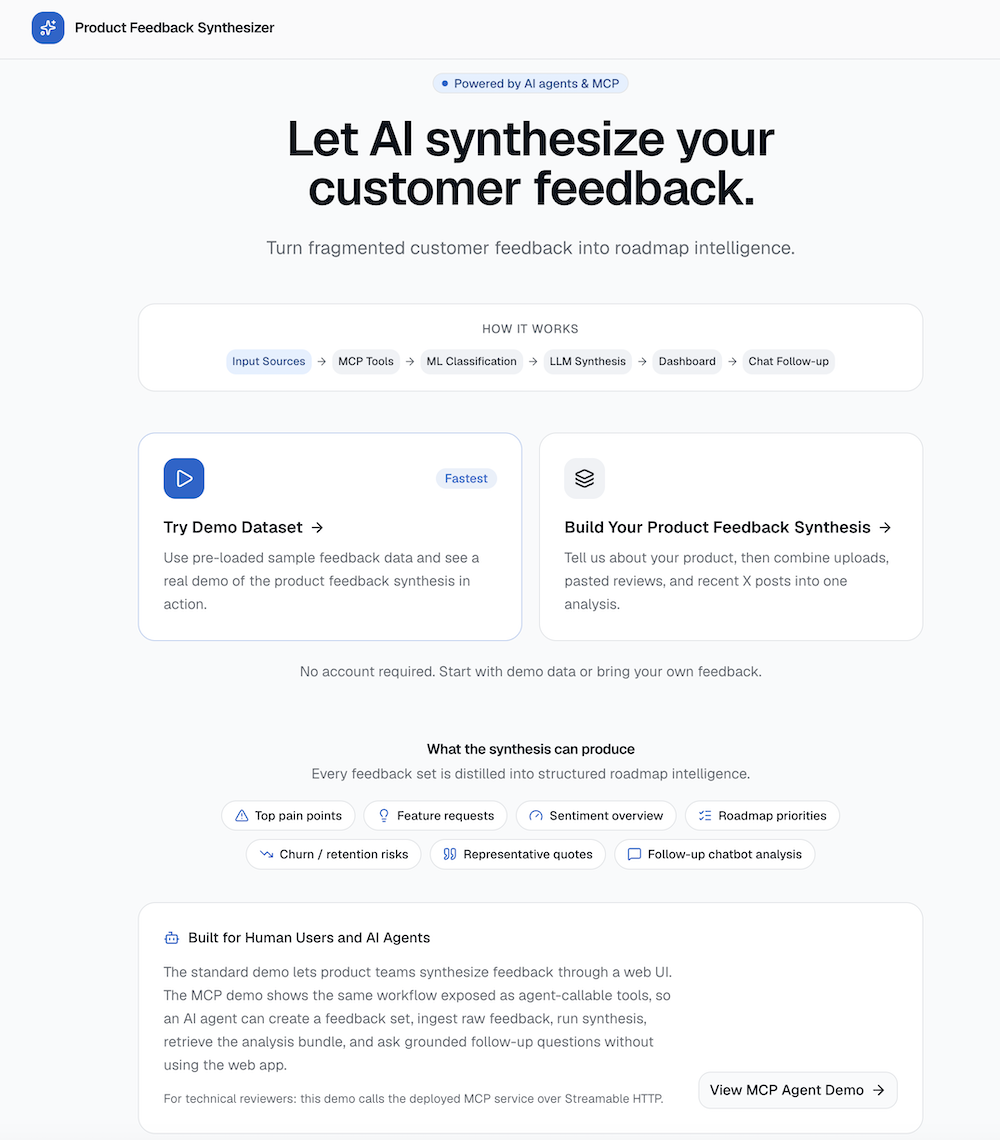
Prototype screens
Choose to upload your own dataset or view a demo.
1 / 10
Because this is a prototype, the value is best understood as directional rather than production-proven. In a real product organization, this type of workflow could reduce hours of manual review, tagging, summarization, and synthesis into a faster analysis loop that helps product managers, founders, and customer-facing teams move from scattered feedback to evidence-backed roadmap decisions. The MCP layer extends that value by allowing agents to trigger and reuse the same workflow programmatically, opening the door to automated research assistants, product ops workflows, customer-success copilots, and third-party integrations.
View the Code Repository on GitHub
Can an Agent Use Your Product? Why I built this prototype application with MCP capabilities...